
The Music Industry in August 2026: What's Changing with Artificial Intelligence, Spotify, Apple Music, and YouTube?
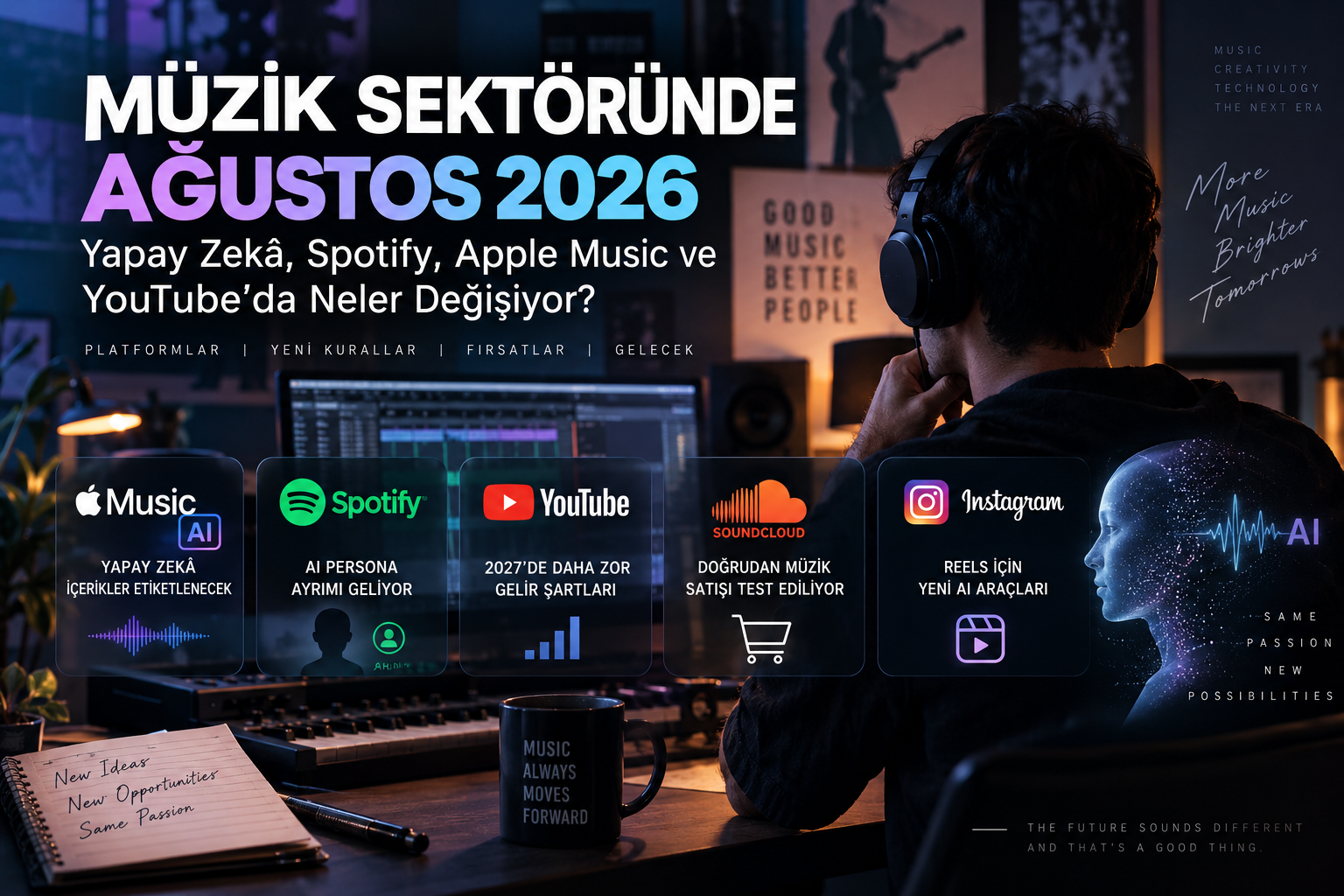
The music industry is undergoing rapid transformation as artificial intelligence technologies are increasingly integrated into production processes. Throughout August 2026, developments from major platforms like Apple Music, Spotify, YouTube, SoundCloud, and Instagram signal significant changes, particularly for independent musicians, songwriters, producers, and content creators.
RouteNote's August 2026 assessment of the music industry included many important developments, from how AI-generated content will be labeled to changes in YouTube's revenue models.
Let's take a look at the key developments together.
Apple Music is preparing to label AI-generated music.
Apple Music is working on a new transparency system to make AI-generated content easier for listeners to understand.
Under the planned system, some content created with the support of artificial intelligence may display an informational label similar to "Made With AI" .
This change is particularly relevant to music producers who use generative AI tools like Suno and Udio.
However, there's an important distinction here. The use of AI doesn't mean the track will be removed from the platform or that it won't generate revenue. The main goal of the new approach is to make it clearer to listeners whether or not AI was used in the music production process.
Therefore, in the future, distributors can expect to see more questions like these on their music upload screens:
- Was the music created using artificial intelligence?
- Was artificial intelligence used in vocal production?
- Was artificial intelligence used in the cover image?
- Was the music video generated by artificial intelligence?
This development shows that the music industry is moving towards a more transparent usage model for artificial intelligence, rather than completely blocking it.
Spotify is dissecting the concept of "AI Persona".
One of the most significant developments at Spotify concerns artist profiles generated entirely by artificial intelligence.
The platform aims to differentiate between projects directed by a real artist but utilizing artificial intelligence in the production process, and projects where a completely fictional AI character is presented as the artist.
This is where the concept of AI Persona becomes important.
For example, a real songwriter writes their own lyrics and creates their own artistic identity, but if they use AI tools in arrangement or music production, this is evaluated differently than a completely artificial artist character.
In contrast, fictional artist profiles whose names, images, personalities, voices, and music are entirely generated by artificial intelligence could be placed in a different category.
Spotify's plan to separate these AI-generated characters from certain algorithmic and editorial recommendations suggests that the distinction between a true artist's identity and an artificial persona will become even more important in the future.
Entering artist information correctly is becoming even more important.
With the increasing use of artificial intelligence tools, metadata used in music distribution is becoming increasingly important.
For a songwriter or independent music producer, the healthiest approach might be to separate human input from AI input as clearly as possible.
For example, the information about a part can be defined as follows:
Artist: Artist or project name
Lyrics: Songwriter
Music Production: AI-assisted production.
Arrangement: Prepared with the support of artificial intelligence.
This type of information can help platforms comply with future transparency policies and also make the creative contributions of humans more visible.
The YouTube Partner Program may become more challenging in 2027.
On the YouTube side, significant changes are on the agenda, particularly affecting new content creators.
According to information reported by RouteNote, YouTube is preparing to make changes to some of its revenue sharing and Partner Program terms starting in 2027.
The new system may introduce higher viewership and watch time criteria, especially for content creators who want access to advertising and YouTube Premium revenue.
This situation directly affects not only traditional YouTube channels, but also music channels.
For an independent musician, simply uploading videos may no longer be enough. How long a viewer stays on the video, whether they return to it, and the level of engagement the content receives are becoming increasingly important.
YouTube is changing its view count calculation system.
One of the major changes YouTube is making in 2026 concerns how view counts are calculated.
With the new approach, the time it takes for a video to start playing can be reflected in the overall view count much faster.
However, this change doesn't mean that all the viewing criteria used to generate revenue have changed in the same way.
Metrics like Engaged Views within YouTube Analytics are becoming increasingly important for understanding the true level of viewer engagement with a video.
Therefore, music channels in particular would be more accurate to evaluate the following metrics together, rather than just looking at total viewership figures:
- Click Through Rate (CTR)
- Average View Duration
- Average Percentage Viewed
- Engaged Views
- Returning Viewers
A video having high view count doesn't always mean high viewer engagement.
Spotify is working on AI-powered remix and cover systems.
Another significant step Spotify is taking in the field of artificial intelligence is its work on enabling users to create new remixes or cover versions of music.
New agreements between Spotify and Merlin, which represents independent music rights, could pave the way for AI-powered music transformations to be carried out within a licensed system.
One of the most important points here is that the system depends on the approval of the rights holders.
With permission from the artist or rights holder, users will be able to create AI-powered versions of specific tracks.
If this system proves successful, in the future it may be possible to generate revenue not only from the original version of a song, but also from licensed variations created by users.
SoundCloud is testing direct music sales.
The low revenue per track offered by streaming platforms has long been a point of contention among independent artists.
SoundCloud is testing a new model that could be an alternative to this problem.
The platform has begun testing a system that allows some artists to sell MP3 or WAV files directly through their own profiles.
This model allows artists to set the price of their own music, and listeners can purchase digital music directly from the artist.
For independent artists, especially those with a small but loyal fanbase, this system could be a far more valuable alternative to streaming revenue.
AI-Powered Video Editing for Instagram Reels
Instagram is also developing new AI-powered editing tools to make the work of content creators easier.
The First Draft feature automatically creates a starter video from uploaded footage, providing content creators with an editable Reel.
This feature can save time, especially for music producers who share the same music video on YouTube Shorts, Instagram Reels, and other short video platforms.
Is AI-generated music being banned?
When all these developments are considered together, the picture that emerges does not suggest that AI-generated music will be completely removed from major platforms.
Instead, the music industry focuses on three core issues:
- Transparency: If artificial intelligence has been used, this should be indicated.
- Copyright: The protection of the rights of human artists and authors.
- Identity distinction: The separation of genuine artists from completely artificially constructed artist personas.
This distinction is particularly important for musicians who write their own lyrics, make their own creative decisions, but utilize AI tools in the production process.
A New Era for Independent Musicians
The next few years will not only see the emergence of new AI tools in the music industry, but will also shape how AI-generated content will be defined, licensed, and incorporated into revenue sharing.
Therefore, independent artists need to pay attention not only to music production but also to metadata, copyright information, distribution agreements, and platform policies.
For a songwriter, producer, or independent music channel, the safest approach would be to clearly state which parts of the creative process are handled by humans and which parts are supported by artificial intelligence.
Conclusion
Developments in August 2026 indicate that the music industry is beginning to establish more distinct rules regarding artificial intelligence.
Apple Music's AI labels, Spotify's AI Persona distinction, YouTube's new performance and revenue criteria, and SoundCloud's direct sales model offer important clues about how the digital music world might be shaped in the coming years.
Artificial intelligence is no longer a passing trend in the music industry. The future debate will be less about whether AI should be used, and more about how it should be used, how it should be regulated, and how creative rights should be protected .
Source: RouteNote – Music Industry News, August 2026
Keywords: Ferhat Gölge, homepage, portfolio, blog, Laravel, software developer
Frequently Asked Questions
Can music generated using artificial intelligence be uploaded to Spotify and Apple Music?
Yes. AI-powered music isn't completely banned. However, platforms may want more transparent information on whether AI was used in the production process. Distributors can be expected to request additional information or clarification on this matter.
What does the "Made With AI" label mean?
Tags like “Made With AI” can be used to indicate to listeners that artificial intelligence was used in the production of a music track, cover art, or related content. This tag alone does not determine the quality of the content, its copyright status, or whether it will generate revenue.
What is the difference between AI Persona and a real artist powered by artificial intelligence?
AI Persona refers to fictional artist projects where the artist's identity, visuals, voice, and personality are largely created using artificial intelligence. In contrast, it's a different matter if a real songwriter, musician, or producer only utilizes AI tools in the production process.
Will using artificial intelligence affect music copyrights?
It can have an impact. Copyright status depends on the nature of the human contribution to the piece, the licensing terms of the AI tool used, and the rules of the distribution platform. Therefore, the commercial use and licensing terms of the tool used must be checked.
What should independent musicians pay attention to in the new era?
It is important for independent musicians to use accurate metadata, clearly state songwriter and producer information, declare the use of AI when necessary, and follow the current policies of platforms such as Spotify, Apple Music, and YouTube. Copyright, distribution, and revenue sharing rules will become even more crucial in the coming period.