
Laravel 13 vs Symfony 8: Which PHP Framework is Better?
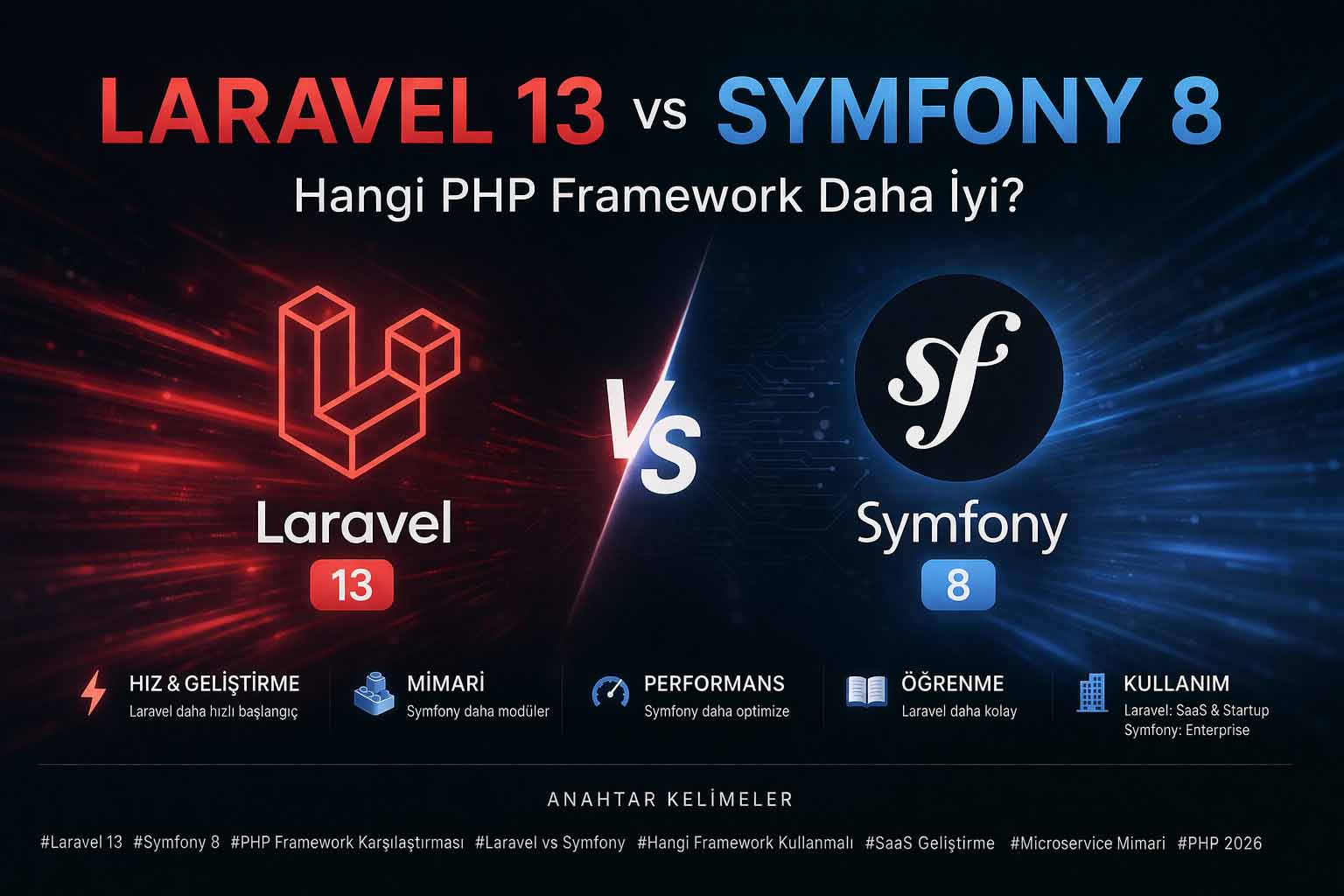
In the web development world, PHP remains one of the most powerful technologies, and the two most popular frameworks within this ecosystem are undoubtedly Laravel and Symfony .
So, as of 2026 , should you choose Laravel 13 or Symfony 8?
In this article, we will compare the two frameworks in detail in a way that everyone can understand.
🚀 What are Laravel and Symfony?
Laravel is a modern PHP framework that prioritizes developer experience (DX) and aims for rapid project development.
Symfony , on the other hand, is a more flexible, modular, and powerful framework designed for enterprise projects.
👉 In short:
- Laravel = rapid development
- Symfony = powerful architecture
🧩 Similarities Between Laravel and Symfony
The two frameworks actually have more in common than you might think:
- It is PHP based.
- It uses MVC architecture.
- ORM support is available.
- CLI tools are available (Artisan & Console)
- API development is supported.
- Cache, Queue, and Event systems are available.
📌 And here's another important piece of information: Laravel uses Symfony components in the background.
⚔️ Key Differences
🏗️ Architectural Approach
While Laravel offers mostly ready-made solutions, Symfony is completely modular.
- Laravel → "Ready-made package"
- Symfony → “Build your own system”
⚡ Development Speed
You can develop projects very quickly with Laravel.
Symfony, on the other hand, requires more configuration.
👉 Result:
- Laravel → Quick Start
- Symfony → more controlled development
🧠 Learning Curve
- Laravel is easy to learn.
- Symfony is more difficult to learn.
In Symfony in particular, Dependency Injection and the configuration system may seem complex at first.
🗄️ Database (ORM)
- Laravel → Eloquent (simpler usage)
- Symfony → Doctrine (a more professional structure)
👉 Eloquent is advantageous for simple projects.
👉 Doctrine is more controlled in large projects.
⚙️ Configuration
Laravel automatically handles many settings.
In Symfony, everything is under your control.
👉 Laravel: minimal settings
👉 Symfony: complete control
🚀 Performance
Symfony is generally more optimized and performs better.
Laravel, on the other hand, may consume slightly more resources due to the conveniences it offers.
🔐 Security
Both frameworks are secure.
However, Symfony offers a more detailed and flexible security structure.
💪 Strengths
🔥 Advantages of Laravel
- Rapid project development
- Extensive package ecosystem
- Easy learning
- Ideal for SaaS projects
- API development is very practical.
🔥 Symfony Advantages
- Suitable for corporate projects.
- Highly flexible architecture.
- Ideal for microservice architectures.
- Long-term stability
- Strong in big data and complex systems.
⚠️ Weaknesses
❌ Laravel
- Complexity can increase in large projects.
- "Magic" builds can make the debugging process more difficult.
- Performance may decrease in some scenarios.
❌ Symfony
- Difficult to learn
- Development time is longer.
- Too complicated for small projects.
🎯 Which Framework Should You Choose and When?
You should choose Laravel if:
- If you want to develop an MVP quickly
- If you are developing a SaaS project
- If you are developing an API + admin panel
- If it's a freelance or startup project
You should choose Symfony if:
- If you are developing a large-scale system
- If you are building a microservice architecture
- If there are very complex business rules
- Long-term enterprise project
🔥 Result
Laravel and Symfony aren't actually competitors; they're tools designed for different needs.
👉 If you want a fast and practical development process → Laravel
👉 If you want a strong and flexible architecture → Symfony
💡 Final Words
Choosing the right framework depends on the size of your project, your team, and your goals.
Remember:
The best framework is the one that best suits your project.
Keywords: Ferhat Gölge, homepage, portfolio, blog, Laravel, software developer