
AI API Token Costs: OpenAI, Claude, and Gemini Model Selection Guide
SEO Information
Meta Title:
AI API Token Costs: A Comparison of OpenAI, Claude, and Gemini
Meta Description:
Compare the token costs of OpenAI's Claude and Gemini models. Learn how to manage AI API costs through input, output, caching, and model selection.
Slug:
yapay-zeka-api-token-maliyetleri-openai-claude-gemini
Category:
Artificial Intelligence / AI Development
Tags:
OpenAI, Claude, Gemini, Token Cost, AI API, Artificial Intelligence API, AiKitMote, Model Selection
Entrance
The use of AI APIs has now become a fundamental part of many digital products. Many processes, such as content creation, job posting preparation, CV analysis, candidate matching, text summarization, and automated response generation, can now be performed using AI models.
However, there is an important point to note here: Not every AI model has the same cost.
A model might be very powerful but unnecessarily expensive for a simple operation. Another model might be more economical but may not yield sufficient results in complex analyses. Therefore, when developing an AI-powered system, it is necessary to consider not only model quality but also token cost, cache usage, output fee, and use case .
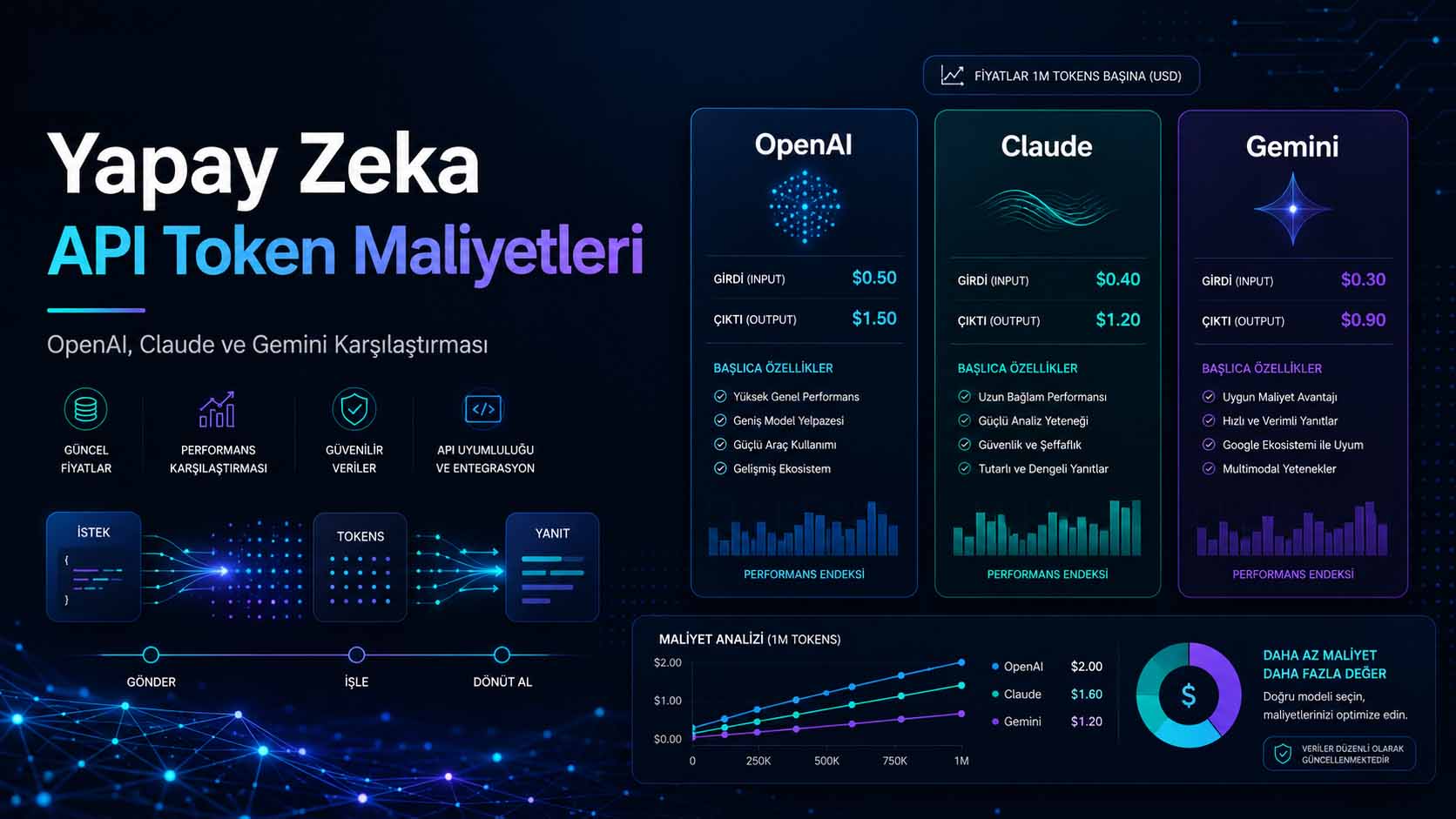
This article will compare the token costs of OpenAI's Anthropic Claude and Google's Gemini models to examine which model is more suitable for which scenario.
What is a token?
Tokens are small pieces of text that artificial intelligence models use to process information. A word might sometimes be a single token, or sometimes it might be broken down into several tokens.
Generally, API costs are calculated using the following logic:
 Toplam Maliyet =
 (input token / 1.000.000 × input fiyatı)
 +
 (output token / 1.000.000 × output fiyatı)
Some providers also offer the following:
 cached input
 context cache
 cache write
 cache hit
 long context
 batch processing
 priority processing
There are also different pricing types, such as those mentioned.
OpenAI Model Token Costs
The prices below are based on USD / 1 million tokens and are prepared according to OpenAI's Standard pricing. OpenAI specifies short context and long context prices separately for gpt-5.5 , gpt-5.4 gpt-5.4-mini , gpt-5.4-nano , and gpt-5.4-pro ; an additional 10% fee is applied for these models on endpoints using regional processing.
| Model | Input | Cached Input | Output | Long Context Input | Long Context Cached | Long Context Output |
|---|---|---|---|---|---|---|
gpt-5.5 | $5.00 | $0.50 | $30.00 | $10.00 | $1.00 | $45.00 |
gpt-5.4 | $2.50 | $0.25 | $15.00 | $5.00 | $0.50 | $22.50 |
gpt-5.4-mini | $0.75 | $0.075 | $4.50 | — | — | — |
gpt-5.4-nano | $0.20 | $0.02 | $1.25 | — | — | — |
gpt-5.4-pro | $30.00 | — | $180.00 | $60.00 | — | $270.00 |
The most important point to consider on the OpenAI side is that the cost of the output token is much higher than the cost of the input token . Therefore, in systems that generate long responses, the cost can increase rapidly.
Claude Model Token Costs
Pricing is slightly different in Anthropic Claude. In addition to standard input and output charges, Claude models include costs for 5-minute cache writes , 1-hour cache writes , and cache hits/refreshes . The Claude documentation uses the term MTok, meaning "million tokens."
| Model | Base Input | 5m Cache Write | 1h Cache Write | Cache Hit / Refresh | Output |
|---|---|---|---|---|---|
claude-haiku-4-5-20251001 | $1.00 | $1.25 | $2.00 | $0.10 | $5.00 |
claude-haiku-4-5 | $1.00 | $1.25 | $2.00 | $0.10 | $5.00 |
claude-sonnet-4-6 | $3.00 | $3.75 | $6.00 | $0.30 | $15.00 |
claude-opus-4-7 | $5.00 | $6.25 | $10.00 | $0.50 | $25.00 |
In the Claude model list claude-haiku-4-5 is listed as an alias, while claude-haiku-4-5-20251001 is the versioned API ID. Therefore, instead of showing them as separate models within the application, it is more accurate to treat one as the main model and the other as an alias.
On Claude's side, prompt caching can provide a significant advantage, especially if long system prompts, lengthy instructions, or repetitive contexts are used.
Google Gemini Model Token Costs
Gemini prices are also calculated based on USD / 1 million tokens . The output price on the Gemini side includes "thinking tokens". gemini-2.5-pro model has two different price levels depending on prompt length.
| Model | Input Text/Image/Video | Audio Input | Context Cache | Output |
|---|---|---|---|---|
gemini-2.5-flash-lite | $0.10 | $0.30 | $0.01 | $0.40 |
gemini-2.5-flash | $0.30 | $1.00 | $0.03 | $2.50 |
gemini-2.5-pro ≤ 200K prompt | $1.25 | — | $0.125 | $10.00 |
gemini-2.5-pro > 200K prompt | $2.50 | — | $0.25 | $15.00 |
Gemini 2.5 Flash-Lite is positioned by Google as one of the smallest and most cost-effective models for scaled deployment. Gemini 2.5 Flash, on the other hand, stands out as a more balanced option with its 1 million token context window support and thinking budget features.
General Ranking from Cheapest to Most Expensive
Based solely on standard input/output costs, the models can be roughly categorized as follows:
| Order | Model | Input | Output | General Commentary |
|---|---|---|---|---|
| 1 | gemini-2.5-flash-lite | $0.10 | $0.40 | The most economical option |
| 2 | gpt-5.4-nano | $0.20 | $1.25 | Very low-cost GPT model |
| 3 | gemini-2.5-flash | $0.30 | $2.50 | Balanced and economical |
| 4 | gpt-5.4-mini | $0.75 | $4.50 | Good balance between quality and cost. |
| 5 | claude-haiku-4-5 | $1.00 | $5.00 | The fast and convenient Claude model. |
| 6 | gemini-2.5-pro | $1.25 / $2.50 | $10 / $15 | Powerful for complex tasks. |
| 7 | gpt-5.4 | $2.50 | $15.00 | Strong general-purpose model |
| 8 | claude-sonnet-4-6 | $3.00 | $15.00 | Quality analysis and production |
| 9 | claude-opus-4-7 | $5.00 | $25.00 | Top-level Claude model |
| 10 | gpt-5.5 | $5.00 | $30.00 | Powerful, but costly. |
| 11 | gpt-5.4-pro | $30.00 | $180.00 | Very special/premium use |
Which Model Should Be Used For What Purpose?
When developing AI systems, using the most expensive model everywhere is not the right approach. A more appropriate approach is to select the model based on the task being performed .
| Use Case Study | Proposed Model Group |
|---|---|
| Short text generation | gemini-2.5-flash-lite , gpt-5.4-nano |
| Simple description or title generation. | gpt-5.4-nano , gemini-2.5-flash-lite |
| Creating a job posting | gpt-5.4-mini , gemini-2.5-flash , claude-haiku-4-5 |
| Creating a CV/candidate summary | gpt-5.4-mini , claude-haiku-4-5 , gemini-2.5-flash |
| Candidate and job posting matching | gpt-5.4 , claude-sonnet-4-6 , gemini-2.5-pro |
| Long document analysis | gemini-2.5-pro , gpt-5.5 , claude-sonnet-4-6 |
| Premium content creation | gpt-5.5 , claude-sonnet-4-6 , claude-opus-4-7 |
| Very specific reasoning/analysis. | gpt-5.4-pro , claude-opus-4-7 |
Model Selection Logic for AiKitMote
In a system like AiKitMote, the most logical approach is to automatically select a model based on the type of operation, rather than imposing a single model on the user.
For example:
 Basit işlem → ucuz model
 Orta seviye içerik üretimi → dengeli model
 Karmaşık analiz → güçlü model
 Premium kullanıcı → daha kaliteli model
This approach keeps costs under control while also offering the user a more sustainable experience.
Example usage:
| AiKitMote Feature | Proposed Model |
|---|---|
| Generating job posting titles | gpt-5.4-nano or gemini-2.5-flash-lite |
| Generating job descriptions | gpt-5.4-mini or gemini-2.5-flash |
| Generating job postings based on company profiles. | gpt-5.4-mini or claude-haiku-4-5 |
| Candidate-job posting matching | gemini-2.5-pro or claude-sonnet-4-6 |
| Detailed CV analysis | gpt-5.4 , gemini-2.5-pro |
| Premium AI-powered recommendations | gpt-5.5 or claude-opus-4-7 |
How can a credit system be designed?
In an AI product, directly displaying the token cost to the user can often be complex. Using a credit system instead is more understandable.
For example:
1 kredi = belirli bir ortalama AI işlem maliyetiHowever, it is important to note that not all models have the same cost. Therefore, a separate cost coefficient can be determined for each model.
Example:
| Model Level | Credit Coefficient |
|---|---|
| Economic model | 1x |
| Balanced model | 2x |
| Advanced model | 4x |
| Premium model | 8x |
| Pro model | 20x+ |
This keeps the system simple for the user, while ensuring that the actual token costs are kept under control in the background.
Suggestions for Cost Optimization
The following methods can be used to reduce AI API costs:
1. Avoid unnecessarily long prompts.
Sending very long system prompts with every request increases costs. Prompts should be simple, clear, and task-oriented.
2. Limit the output length.
The cost of the output token is generally higher than the cost of the input token. Therefore, limiting the length of the response provides significant savings.
Example:
Cevabı maksimum 120 kelime ile sınırla.3. Evaluate cache usage.
If the same system prompt or the same context is used repeatedly, caching can reduce costs.
4. Use inexpensive models for simple tasks.
Using the premium model for every task creates unnecessary costs. For tasks like title, short description, and summary, the economical models may suffice.
5. Keep model-based logs.
For cost control, it is important to record the following information with each AI request:
 provider
 model
 input_tokens
 output_tokens
 cached_tokens
 estimated_cost
 user_id
 feature_name
These logs make it possible to clearly see how much each feature costs.
Conclusion
AI API costs are not just a technical detail; they directly impact a product's profitability, scalability, and pricing strategy.
OpenAI's Claude and Gemini models each offer advantages in different use cases. The important thing here is not choosing the most powerful model, but choosing the right model for the right task .
This approach is particularly important in a multi-vendor AI architecture like AiKitMote, because the system can both keep costs under control and offer the user a more flexible, sustainable, and professional AI experience.
Publication Note
The prices in this article are based on official pricing information checked as of May 12, 2026. AI providers may change model names, prices, caching systems, or pricing policies over time. It is recommended to check the relevant provider's official pricing pages before using the current information.
Keywords: Ferhat Gölge, homepage, portfolio, blog, Laravel, software developer
Frequently Asked Questions
What is the cost of the token?
The token cost is the API usage fee calculated based on the number of tokens required for the text sent to the AI model and the response received from the model.
What is the difference between input and output tokens?
An input token is data sent from the user or system to the model. An output token is the response generated by the model.
Why is the output token more expensive?
Most AI providers consider the process of generating answers for the model to be more costly. Therefore, the output token price may be higher than the input token price.
Which is the cheapest AI model?
Among the models on this list, one of the most economical options is gemini-2.5-flash-lite . On the OpenAI side, gpt-5.4-nano is one of the low-cost options.
Is it correct to use the most powerful model in every transaction?
No. Inexpensive models should be preferred for simple operations, while more powerful models should be used for complex analyses. This approach reduces costs and balances system performance.
Is a credit system a sensible option for AiKitMote?
Yes. The credit system makes AI usage more understandable without presenting token costs in a complicated way to the user. In the background, model-based real-time cost calculations can be performed.