
Ferhat Gölge
Computer Worker
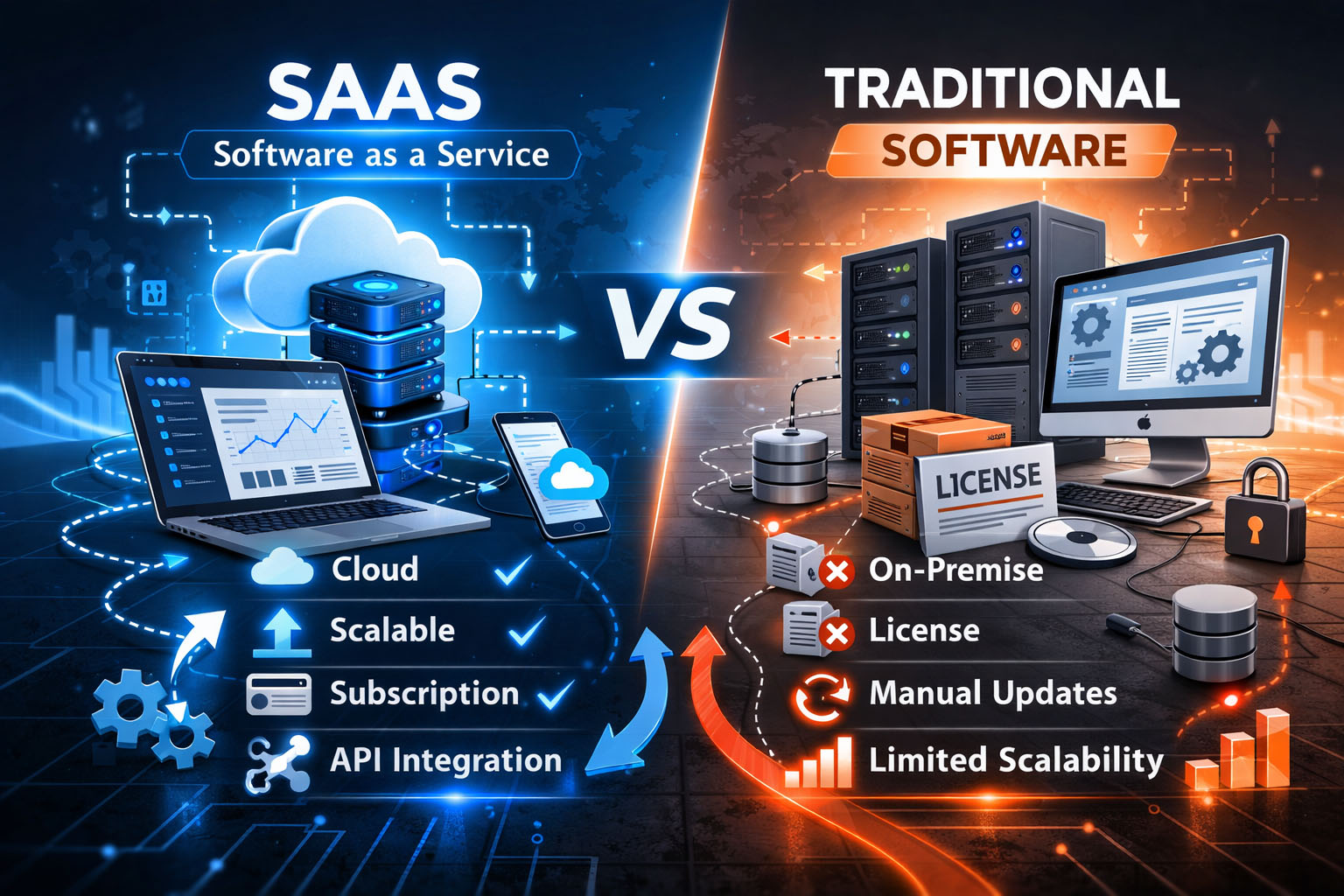
SaaS vs Traditional Software: Why Did the Modern Software Model Change?
SaaS vs Traditional Software: Why Did the Modern Software Model Change?
The software world has undergone a major transformation in recent years. In the past, companies would buy the software they needed, install it on their own servers, and use the same version for years. This model is known as Traditional Software .
Nowadays, software is increasingly shifting to the SaaS (Software as a Service) model. In the SaaS model, software is offered as a service over the internet, and users typically access the system through a subscription-based access model .
This article will examine the differences between SaaS and traditional software models , their technical advantages, and which model is more suitable for businesses.
What is Traditional Software?
The traditional software model is the classic software distribution model where software is installed on the user's computer or company server by purchasing a license .
In this model:
- The software is purchased with a one-time license.
- Installation is performed on local servers.
- Updates are applied manually.
- Maintenance and infrastructure responsibility lies with the customer.
Examples:
- old ERP systems
- desktop accounting software
- in-house CRM systems
This approach has been the standard model in the enterprise software world for many years.
What is SaaS (Software as a Service)?
The SaaS model is a modern software distribution model where software is offered as a service over the internet . Instead of purchasing the software, users typically use it through a monthly or annual subscription .
On SaaS platforms:
- The software runs on cloud infrastructure.
- Users access the system via the web.
- Updates are done automatically.
- Infrastructure and maintenance are managed by the service provider.
Examples of popular SaaS platforms include:
- Salesforce
- Shopify
- Notion
- Slack
- Google Workspace
It can be given.
SaaS vs Traditional Software: Key Differences
| FeatureSaaSTraditional Software | ||
| Setup | Via the web | Local installation |
| Pricing | Subscription | Purchasing a license |
| Updates | Automatic | Manual |
| Infrastructure | Cloud | Local server |
| Scalability | Very high | annoyed |
| Care | Service provider | customer |
These differences clearly demonstrate why the SaaS model is rapidly becoming widespread.
Advantages of the SaaS Model
1. Low Initial Cost
With traditional software, companies typically have to make high licensing fees and infrastructure investments.
In the SaaS model:
- There are no infrastructure costs.
- Installation cost is low.
- Payment is made only for usage.
This provides a significant advantage, especially for startups and small businesses.
2. Scalable Infrastructure
SaaS systems typically operate on a cloud-based architecture .
In this way:
- The system can automatically scale as the number of users increases.
- Server capacity can be increased dynamically.
- global access is possible
In traditional software, new users typically require new server investments.
3. Automatic Updates
In the traditional software model, for each update:
- new version installation
- technical team intervention
- maintenance period
It may be necessary.
In a SaaS model, all users use the most up-to-date version at the same time.
4. Remote Access
Because SaaS systems operate over the internet, users can:
- from the office
- from home
- from mobile devices
They can access the system.
This situation, especially with the rise of remote work culture, has rapidly increased the use of SaaS.
Disadvantages of the SaaS Model
Although SaaS offers many advantages, it also has some disadvantages.
1. Internet Addiction
Internet connection is required to access SaaS platforms.
2. Data Security Concerns
Some companies may not want to store their data on third-party systems.
3. Long-Term Costs
In some cases, long-term subscriptions can be more expensive than a licensing model.
Why is SaaS Important for Software Developers?
The SaaS model is not just a distribution method for software developers, but also a new product development approach.
The following points are important in the SaaS development process:
- multi-tenant architecture
- subscription and license management
- API-first design
- microservice architecture
- CI/CD pipeline
- automated scalable infrastructure
Therefore, modern SaaS platforms are generally developed with the following technologies:
- Laravel / Symfony
- Node.js
- Docker
- Kubernetes
- Redis
- Queue systems
Which Model Makes More Sense?
In today's technology world, most new software projects are developed using the SaaS model.
Traditional software typically includes:
- in-house systems
- in institutions with high security requirements
- in applications requiring special infrastructure
is preferred.
However, for modern web applications and B2B platforms , the SaaS model offers a more flexible and scalable solution.
Conclusion
The fundamental difference between SaaS and traditional software models lies in how the software is distributed and managed .
While traditional software is based on a local installation and licensing model, SaaS platforms offer a cloud-based, subscription-oriented, and continuously updated structure.
In the modern software development world, the SaaS model is increasingly becoming the standard and is considered the most suitable architectural approach, especially for B2B platforms, API services, and subscription-based applications.